


Research investigates chemical compound in ÌÇÐÄvlog¹ÙÍø winter air
April 2, 2021
Rod Boyce
907-347-9105
Results of the three-year research project, which is funded by the National Science Foundation, could affect how government regulators and elected officials choose to combat the region’s poor air quality.
Scientists discovered hydroxymethanesulfonate in airborne fine particulate matter two years ago during an analysis of ÌÇÐÄvlog¹ÙÍø air samples.
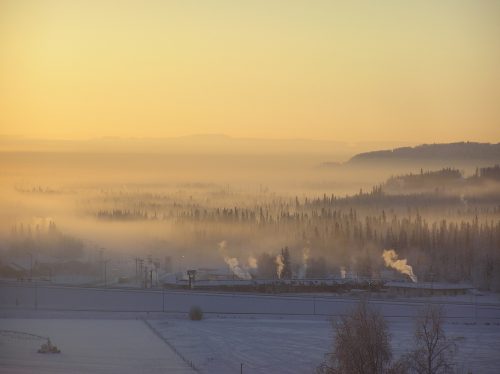
Analysis revealed the hydroxymethanesulfonate is a component of the PM2.5 fine particulate matter — particles less than 2.5 micrometers — that often plagues ÌÇÐÄvlog¹ÙÍø in winter, said assistant professor Jingqiu Mao at the Geophysical Institute.
“Our goal for this National Science Foundation project is to understand how hydroxymethanesulfonate is formed and its fate during winter in ÌÇÐÄvlog¹ÙÍø,â€� Mao said. “We know that hydroxymethanesulfonate has two precursors — sulfur dioxide and formaldehyde.â€�
Sulfur dioxide reacts with formaldehyde to form hydroxymethanesulfonate in aerosols or droplets.
Sulfur dioxide, however, can also react with oxidants to form sulfate. But the formation and properties of the sulfate and hydroxymethanesulfonate compounds differ widely.
A sizable fraction of what a U.S. Environmental Protection Agency database had reported as sulfate in ÌÇÐÄvlog¹ÙÍø air pollution was actually hydroxymethanesulfonate, according to the research proposal.
That mischaracterization could affect efforts to reduce the area’s PM2.5 level by bringing attention to formaldehyde as a potential driver.
That’s what other researchers determined when studying the winter haze in Beijing, China, which also has high levels of hydroxymethanesulfonate. A 2018 study published in Geophysical Research Letters found that reducing sulfur dioxide production by the “shutting of coal plants in the Beijing area and adoption of stricter SO2 emissions controls would be ineffective against severe haze.� That's because formaldehyde, not sulfur dioxide, drives production of hydroxymethanesulfonate.
“Policymakers may need instead to focus on quantifying and reducing sources of HCHO , such as from gasoline and diesel engines,� that 2018 study concluded.
Knowing how hydroxymethanesulfonate forms in ÌÇÐÄvlog¹ÙÍø is important, according to Mao and atmospheric chemistry professor Rodney Weber at the Georgia Institute of Technology. Both of its precursor chemicals — sulfur dioxide and formaldehyde — escape during the burning of wood and the combustion of fossil fuels.
The burning of wood for home heating has been found previously to account for the largest portion of fine particulate matter in ÌÇÐÄvlog¹ÙÍø’ bad winter air.
“If you want to suggest effective ways to control and lower PM2.5 mass, and since hydroxymethanesulfonate at times can be an important contribution to PM2.5 mass, one needs to know where it comes from,� Weber said.
ÌÇÐÄvlog¹ÙÍø is an ideal place for the study, said research assistant professor Jason St. Clair of University of Maryland Baltimore County.
"ÌÇÐÄvlog¹ÙÍø is a great place to study this chemistry because the low-light conditions of wintertime in high latitudes remove a normally important atmospheric chemistry variable: sunlight, which usually drives atmospheric oxidation,â€� he said.
ÌÇÐÄvlog¹ÙÍø is under mandate by the EPA to improve its air.
Weber, an expert in aerosol measurements, wrote the grant proposal and is the lead principal investigator for the ÌÇÐÄvlog¹ÙÍø project. Mao is the lead UAF researcher on the project, and St. Clair is the lead for the University of Maryland, Baltimore County. St. Clair has, in conjunction with NASA Goddard Space Flight Center’s Atmospheric Chemistry and Dynamics branch, has analyzed formaldehyde elsewhere in the world.
ADDITIONAL CONTACT: Jingqiu Mao, Geophysical Institute, 907-474-7118, jmao2@alaska.edu
NOTE TO EDITORS: A full-length story version about the research is available on the Geophysical Institute website at .